(This works best if you imagine it being read aloud by someone like Derek Jacobi)
Although the events I am about to relate took place nearly thirty years ago, I can remember them as clearly as if it had been last week. I was but twenty-one years of age, and not given to thinking about, let alone believing in, the supernatural, until one particular night in the cold winter of '86/87 changed that forever...
At that time I was earning my living as an assistant warden at Sandwich Bay Bird Observatory, on the Kent coast. I should say at the start that if you have visited that establishment in recent times, the thoroughly modern Field Centre which now occupies the site is a far cry from the building which stood there in my day, and where I lived for a whole year in conditions which might not unreasonably be described as 'squalid'.
This, the original Observatory building, comprised several low huts, interconnected by corridors, such as would once have been found on many a wartime airfield. Indeed, these particular huts had once been used as officers' quarters, a circumstance which, as shall be seen, has a most pertinent bearing on what follows.
It was the regular custom of the dozen or so inhabitants of the Observatory at that time to repair of an evening once or twice a week to one of several local inns once work was finished for the day, and there to while away a few pleasant hours imbibing the excellent Kentish ales, playing pool or darts, and generally relaxing in convivial company. Our most regular watering hole was undoubtedly the Fleur de Lis in Sandwich (since converted into a 'bar' and restaurant, but in those days a good old-fashioned drinking pub); on other occasions the St Crispin or The Blue Pigeons in Worth would be patronised.
On the night in question we were returning from the first-mentioned hostelry, in good spirits (no pun intended), but I must stress to the reader that, though I cannot vouch for the others, I myself was certainly not so inebriated that the following experience can be attributed to any kind of alcohol-induced hallucination. This is most important to bear in mind.
It so happened that, on this particular occasion, I was the first to enter the building, and it thus fell to me to turn on the lights. In order to get to the light switches, I had to walk a short distance across the hall in darkness, passing as I did so a corridor on my left, which led to the dormitories. As I crossed this, something made me pause and look down the corridor. To my great surprise, for I had supposed the building to be empty, there was a figure, no more than a dark shape, but still clearly a figure, moving (as I was to recall later, almost gliding rather than walking) away from me. I saw it most clearly, especially as it passed a window through which the moon was shining brightly.
Puzzled, I turned to my companions, who were now following me through the door. "Who was that walking down the corridor?" I asked. "I thought everyone was out this evening."
There was an uneasy pause, then someone, I forget who, spoke: "Ah, that'll be Jake."
"Jake? Who's Jake?"
Another pause.
"The Obs Ghost."
"A ghost? Nonsense. I don't believe in ghosts."
"Plenty of people have seen Jake, whether they believe in him or not."
In the Common Room, with the lights comfortingly on and a fire blazing in the hearth, the stories started to come out. 'Jake' had been an airman killed in the First War, and had been billeted in this very building. The place he frequented was the corridor down which I'd just seen a shadowy figure move, and it seemed to be an unwritten rule that he was never mentioned to newcomers until they encountered him for themselves.
Almost everyone living at the Observatory had either seen something, or heard footsteps in that corridor. A former warden, who had lived in the building on his own for months at a time in the sixties and seventies, said he got so used to hearing footsteps outside his room at night that he stopped worrying about it and just accepted that it was Jake going about his nightly business.
Another warden had had a small dog, a normally placid animal, which one night had suddenly jumped up and started barking furiously at a corner of the Common Room adjacent to the corridor, for all the world as if an invisible person were standing there.
I didn't know what to make of all this. I hadn't given ghosts or the supernatural a moment's thought since I was a child, and had come to believe (or perhaps been indoctrinated to believe) that such things were unscientific nonsense, no more worthy of serious consideration than astrology or homeopathy. But now I had seen something inexplicable for myself. There could not possibly have been any living person in that corridor at the time I saw the figure, and yet I had seen someone, or something. My experience could not even be explained away by the power of suggestion, as I had never heard of the occurrence of a ghost in that particular corridor, or indeed anywhere else in the building. The thought of the place being 'haunted' had simply never entered my mind.
But further research has taught me that this is often the way with ghosts, whatever they may be. Those who actively seek them rarely find them, yet time and again they appear to those least expecting them, those who had previously dismissed them. It is almost as if they wish to challenge our lack of belief.
I had one further encounter with Jake that winter, on this occasion auditory rather than visual. One night myself and another warden were alone in the building, having opted for a night in rather than yet another night in the Fleur. We were in the Common Room, pursuing some of the tedious, but necessary clerical work generated by the work of a bird observatory. It was a remarkably still night, with not a breath of wind outside. Winter Moths fluttered at the windows. Around nine o'clock we heard the distinct sound of the inner fire door (between 'Jake's corridor' and the outer entrance hall) opening and closing. This was strange, as we had not heard the familiar rattle of the outer door opening, but maybe whoever had come in had somehow managed to open and close that door quietly. We looked up and waited a moment, expecting someone to come into the Common Room, then when no-one appeared I went out to see who was there. But there was no-one there. The outer door was still firmly closed. We searched the entire building, but we were the only two people in it. A spring-loaded fire door had, without any doubt, opened and closed itself.
It is safe to say that those two incidents, and other people's experiences of 'Jake' at least opened my mind to the possibility of things beyond our immediate understanding. I still wouldn't say that I believe in ghosts, at least not in the sense of them being the spirits of the dead, but neither would I totally dismiss reports of them out of hand. There are stranger things in Heaven and Earth...
Post Script
I would be very interested to hear of anyone else's experiences or stories of Jake, the Sandwich Bay ghost, and also to learn what happened to him when the old building was demolished. Did he disappear forever, or has he moved into the altogether more salubrious accommodation of the new Field Centre?

Friday, 31 October 2014

Friday, 5 September 2014
EU to Ban High-powered Optics
by Nathan Rare
Birders are rallying round (and also flocking) to vent their fury as Brussels bureaucrats unveiled their latest plan to erode the "lifestyles and choices of ordinary people".
It follows the banning this week of binoculars with a higher magnification than 6x and spotting scopes above 15x. In further moves which seem certain to provoke outrage amongst the nation's birders, tripods will be restricted to a maximum fully extended height of 1.2m, and DSLR burst rates will not be permitted to exceed 3 frames per second.
EU Commissioner for Birding Affairs, Lars Ole, speaking from his palatial penthouse suite at the Stockholm Hilton, said, "This new legislation is essential to improve standards of fieldcraft. For years now, people have been using high-powered optics to avoid the need to learn any kind of fieldcraft. We feel that reducing magnifications will improve the situation dramatically, especially in the UK, where birders' field skills are lamentable."
Condemnation of the announcement was swift and almost universal. Derek Sandpiper, 52, a twitching veteran with a British list of "nearly 300", said, "This will just mean that I need to get even closer to the bird than I do already. Fieldcraft? I thought that's what people did in the 19th century. Things have moved on since then, mate." He went on to say that he would be stockpiling "enough pairs of 10x42 Swaro ELs and 30-70x eyepieces to see me out. I can afford it, so bollocks to the EU".
L.G.R. Falarga, 52, of the IQ40 Club seemed rather confused by the news: "I've been saying for years that everyone should vote UKIP because of their thoroughly sound environmental policies, and this just proves my point. But on the plus side, maybe some people will give up birding, which would be a good thing. There are far too many birders in this country nowadays. And it might also save a lot of time chasing up reports of Great Knots and Long-toed Stints, as they'll be too distant for anyone to string them in the first place. Maybe we shouldn't vote UKIP after all? I don't know really. What planet am I on again?"
However, Billy Boring, 52, who described himself as a "keen patcher" said, "I couldn't give a toss really. No-one else ever goes to my patch, so I can get as close to the birds as I like, and it doesn't matter if I flush them. I don't even own a pair of binoculars, let alone a scope."
While Mrs Bessy Ducker, 93, a keen back garden birdspotter said, "How am I supposed to identify anything down the end of my garden with 6x binoculars? What do they expect me to do, go outside? At my age? It's fucking ridiculous. I'm 94, you know!"
When asked about the proposed decrease in permissable tripod height, Mr Ole was evasive. "Um, I can't remember – I think it was something to do with the legs obstructing air flow near wind turbines."
And the DSLR burst rate restriction? "Oh, that's simply because people at twitches with machine gun rate burst speeds are annoying twats."
Tuesday, 12 August 2014
Experts Predict Best Autumn EVER!!
by Nathan Rare
Twitchers throughout the country are
set to spend tens of thousands of pounds EACH to charter planes,
boats and helicopters after experts predicted that this autumn could
be the best EVER for rare birds in the UK.

A boat similar to one which might be
chartered by twitchers
Eric Twatt, of Forecast-A-Rare
Technology Ltd, made his startling prediction after studying ancient
manuscripts, the movements of eels, sunspot activity and conducting
lengthy conversations with Princess Diana via a medium.
Mr Twatt, 52, said “All the portents
are in place for a mega rare autumn. According to my calculations,
MILLIONS of birds never seen before in Britain are poised to make
epic journeys in a bid to claim their place on the British List.

One of the many birds never seen before
in Britain
“Birds from all over the globe will
descend on the country between now and the end of November, bringing
CHAOS to the roads and long delays at all major airports. Twitchers
literally won’t know which way to turn.”
Mr Twatt’s exciting predictions were
immediately confirmed by The Reverend John Vague, a fundamentalist
Baptist preacher from Wisbech, who said “This has long been
foretold in the Bible, for example Wallace ch.14, v.12: And
lo!, the winds shall rise mightily and blow from the eastern lands of
Dauria, and yet further east thereof, and from the west also shall
they come (but not at the same time). Great shall be the accompanying
precipitation, and a plague of Locustellas shall fall from the sky.
“And I’m sure there was something
about the Moon as well. You always get rare birds when there’s a
Moon.”

The Moon. It’s a Sign...
Avid twitcher Ross Franklin, 52, said
“I can’t wait. It’s about time we had a decent autumn, and
hopefully it won’t all be on Shetland, because I can’t afford to
go there. Or Scilly. And Ireland doesn’t count, of course.
Something like a mainland Canada Warbler would be nice, but not a
gull please. I fucking hate gulls.”

Adult Scruttock’s Gull, showing the
diagnostic flange coverts, or something
But others in the birding world sought
to play down Mr Twatt’s sensational forecasts. Len Savee, 52,
President of the IQ40 Club®
said “Eric Twatt is absolutely clueless. Easily in the bottom 6.73%
of birders ranked according to ability. He once claimed to have seen
a Pacific Swift when everyone knew he was miles away at the time. He
just wants to get his name in the papers and be on the telly.”
A spokesman from information service
Birders’ Rarity Alerts who insisted on remaining anonymous agreed.
“He might be right. He might not. Who cares really? I’ll still be
raking it in from subscriptions and app sales whether there’s
actually anything to go and look at or not!”
He later retracted this statement when
he realised how many customers he was losing to the growing number of
free Twitter news services.
Saturday, 9 August 2014
Silly Season
I was highly alarmed to read this today, until I realised that ‘the Daily Express’ is just another one of those spoof news sites which litter the Internet these days. Oh how I laughed to think that I'd fallen for something as ridiculous as that.
Good job it’s not a real news site really, as there was also this! Blimey – the end of the world AND some wind and rain – I don’t think I could cope with that. Tom Logan, a retard from Plagiarismsville (near Bristol, I think), said “Well, I heard where it said something in the Bible about the Moon being something to do with the end of the world, or something, and it proper shit me up, like”.
But ‘Bertha’ might at least fart a few decent birds our way, although more likely off the coast of Cornwall rather than this far inland. It certainly looks pretty grim first thing tomorrow, so I think I’ll stay in bed and see whether there’s anything around anywhere in the Midlands before venturing out. Trouble is, everyone else will probably do the same, and Leicestershire’s first Wilson’s Petrel will be pattering its yellow webs over the water at Eyebrook with no-one there to see it.
Bargain of the year (even better than the 2012 Suffolk Bird Report I found in a charity shop in Southwold for two quid recently) – I bought a hardback Collins Bird Guide today, in really good condition, for 20p from a stall at the local fete. I even paid for it with a 50p and made sure I got my 30p change. Mwa-ha-ha-ha-ha-ha-ha-ha-haaaaa.
Friday, 30 May 2014
Affordable Art Sale
I'm having a bit of a sale of a few pieces of original art, all priced between £35 & £55.
Full details on my new 'serious' website, which you may have noticed has rather taken over from this one recently!
http://andrewmackay.info/art-2/affordable-art-sale/
Update - the Nightingale and the landscape format Hare are now sold.

Full details on my new 'serious' website, which you may have noticed has rather taken over from this one recently!
http://andrewmackay.info/art-2/affordable-art-sale/
Update - the Nightingale and the landscape format Hare are now sold.
Thursday, 27 March 2014
March PWC roundup
With other commitments from Saturday till Monday, I shan't be going to Eyebrook again this month (unless someone else finds something mega there today or tomorrow!), so that's March done for me, and on the whole I shall be glad to see the back of it, to be honest. Seven visits totalling nearly 27 hours for a measly six new birds for the year, bringing the total to 96 species and 107 points.
But at least a couple of the birds were unexpected: a pair of Egyptian Geese (woohoo!) on the 9th, and a Nuthatch on the 21st. The latter appears to be the first record for the site for several years, and to show just how scarce Nuthatches are around Eyebrook, here's the BirdTrack map for the species. The red flag in the middle is my record for this month, and there are no others in about a 5 mile radius. Which is odd really, as there is plenty of suitable woodland in the area. No doubt it's largely down to under-recording, but there's a definite Nuthatch 'hole' here!

Apart from these, the only other bird of any real interest during the month was a nice summer adult Med Gull which flew over me at the Stoke Dry car park on the 18th. The other three new species were Oystercatcher, Redshank and Sand Martin, of which there were just two on the 21st, in contrast to the hundreds at Rutland Water.
So that's it for the winter; from next week the list should start to rise dramatically as the migrants start to arrive...
Wednesday, 26 February 2014
Boom!
February has been a surprisingly good month for me at Eyebrook, and I reached my rough target of 90 species for the year this morning with amazing views of the Bittern at the inflow. Definitely a case of third time lucky, having failed to see it last Friday and again on Saturday. This bird has the rather odd habit of feeding under the trees, usually well away from the inflow stream, and today it was doing just that, although it did walk along the stream at one point.
Having never photographed a Bittern before, I was quite pleased to get these first few shots, but even more pleased with the final ones, taken from the bridge in excellent light at a range of about 25 yards. These are just a few from the 150+ I took:

Initial views under the trees were OK, but unspectacular

Then it moved into the open

Posed a bit...

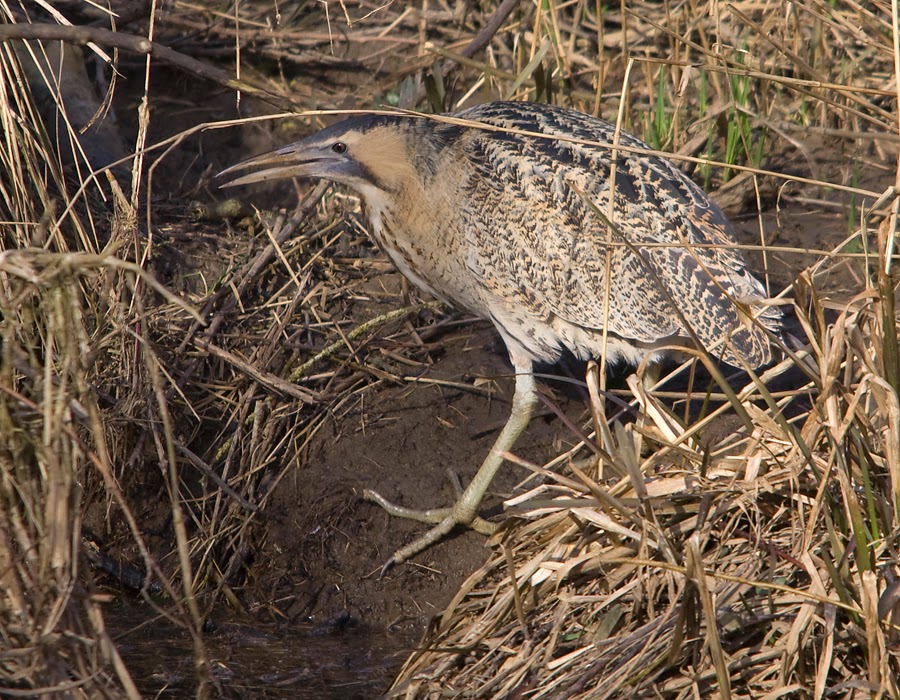
Then appeared much closer at the edge of the stream


Came a bit closer still, then...

Boom! (it didn’t actually go ‘boom’, of course, that’s just a way of expressing satisfaction in modern birding parlance).
After this it walked off back into the trees, where I later saw it catch and eat a vole. In all, it was on view for about an hour.
Other February highlights were the site’s first ever Cetti’s Warbler, which I heard calling at the inflow on the 16th, and a Peregrine on the 2nd. The remaining new species for the year were Pintail, Tawny Owl, Grey Wagtail and Mistle Thrush.
Sunday, 2 February 2014
Groundhog Day
If any groundhog living near Eyebrook (Stoke Dry Steve or Great Easton Graham, perhaps?) had poked his head out of his burrow today, he would definitely have seen his shadow, thereby predicting another six weeks of winter. And he would probably also have wondered how the hell he'd come to wake up in the UK after going to sleep in North America.
But apart from any biogeographically inaccurate rodent-based weather forecasting fantasies, today had a definite Groundhog Day feel about it as I paid my second visit in three days to the patch. As it was a nice day (almost spring-like in fact, whatever any fictitious groundhog might say) I decided to walk around the entire 5 mile perimeter of the reservoir, something I've never done before in my 29+ years of watching the site on and off.
My 'reward' for this ridiculously optimistic trek was a Peregrine, and the satisfaction of knowing that there really wasn't anything else new for the list anywhere around the reservoir.
Friday, 31 January 2014
January PWC Update
As usual at this time of year I seem to have gone into a sort of cyber-hibernation. Nothing on here since before Christmas and only one post on Facebook so far this year. But I have been making the effort to get out to Eyebrook for the Patchwork Challenge, with a reasonable haul to show from 6 visits totalling 22.5 hours during the month.
 |
| Eyebrook on an atypically nice day |
 |
| Eyebrook on a more typically grim day (this morning) |
Before I started, I had a rough target of 80 in mind for January, and I’ve managed to exceed that. As of today, my total stands at 83 species and 90 points. Not surprisingly given the indifferent weather we’ve experienced so far this year, there haven’t been any major surprises amongst the wildfowl. The Velvet Scoter very unsportingly buggered off before the end of 2013, leaving the Ring-necked Duck as the only noteworthy duck present. I say ‘present’; in fact it’s been absent more than it’s been present this month, and I only saw it on my first visit. But that was enough to get it on the list with its very welcome 3 points.
By far the best bird of the month was a female/imm Merlin over the dam on the 17th – this was one I really didn’t expect to see during the year, and a definite bonus, despite being only worth 2 points. Other highlights were a Water Rail at the inflow on the 22nd (another unexpected one), the regular Barn Owl on the 17th, and a Willow Tit on the 25th. Other bits and pieces worth mentioning are Little Owl (first bird of the year), up to 6 Smew, Kingfisher most visits, 1 Lesser Redpoll and a Chiffchaff.
Birds notable by their absence so far include Mandarin and Red-crested Pochard, both of which I saw in December, Grey Wagtail and Mistle Thrush. Ridiculously, Starling very nearly made it onto this list as well, until I saw a small flock flying over the dam this morning! There are also no Goosander or Pintail at Eyebrook this winter, and no gull roost, although I did pick up Yellow-legged Gull on the 25th.
So far I’ve had at least one addition to the list on every visit, but I don’t expect that to continue in February! I’d be happy with 90 species by the end of the month.
By far the best bird of the month was a female/imm Merlin over the dam on the 17th – this was one I really didn’t expect to see during the year, and a definite bonus, despite being only worth 2 points. Other highlights were a Water Rail at the inflow on the 22nd (another unexpected one), the regular Barn Owl on the 17th, and a Willow Tit on the 25th. Other bits and pieces worth mentioning are Little Owl (first bird of the year), up to 6 Smew, Kingfisher most visits, 1 Lesser Redpoll and a Chiffchaff.
Birds notable by their absence so far include Mandarin and Red-crested Pochard, both of which I saw in December, Grey Wagtail and Mistle Thrush. Ridiculously, Starling very nearly made it onto this list as well, until I saw a small flock flying over the dam this morning! There are also no Goosander or Pintail at Eyebrook this winter, and no gull roost, although I did pick up Yellow-legged Gull on the 25th.
So far I’ve had at least one addition to the list on every visit, but I don’t expect that to continue in February! I’d be happy with 90 species by the end of the month.
Sunday, 22 December 2013
Limbering up
Ten days to go till the 2014 Patchwork Challenge starts, so I thought I'd spend a few hours at Eyebrook this afternoon to get a bit of practice in. The drake Velvet Scoter was still off the dam, although I didn't bother walking down to see it as there were no less than nine cars parked by the gate. Hopefully it will stay till the start of the year to get on everyone's year list and then piss off, so I can have the place to myself again! Also, the female Ring-necked Duck put in a surprise re-appearance today, having been last seen on 10th November. It was in exactly the same place as before, just south-west of the island. Interestingly, the pale band on the bill looks more obvious now, lending weight to my theory that it was a juvenile/1st-winter when it first turned up in October.
Other bits and pieces included a Barn Owl flying across the reservoir towards Stoke Dry at 13:25 - I was initially puzzled as to why this was flying around at that time of day, until two cretins came into view, walking along the reservoir side of the hedge and flushing everything. I didn't shout at them, partly because the bloke looked a bit hard, but also because without them I wouldn't have seen the Barn Owl! Also of interest were an adult Caspian Gull (as far as I could tell - everything I could see on it looked good) and a female Mandarin off the island, and a Kingfisher and a Lesser Redpoll at the inflow.
I'm really looking forward to the challenge - I think Eyebrook will have a good year next year; there are certainly plenty of birds there at the moment, anyway.
The other notable sighting of the day was an out-of-range Wanstead birder and friends, on their way back from the Yorkshire Ivory Gull - hopefully they had decent views of the scoter, although it looked from a distance as if it might not have been quite as close to the dam today as it sometimes is.

Sunday, 15 December 2013
Just Say No!
I think I was vaguely aware from a Facebook post a while back that there was a Washington Post article about British twitching in the offing, but had forgotten all about it until I was alerted to it on Twitter this morning. So I had a look.
http://www.washingtonpost.com/world/in-britain-bird-watching-gone-wild/2013/12/14/87d5766a-61a3-11e3-a7b4-4a75ebc432ab_story.html
http://www.washingtonpost.com/world/in-britain-bird-watching-gone-wild/2013/12/14/87d5766a-61a3-11e3-a7b4-4a75ebc432ab_story.html
The article gets off to a bad start, as far as I’m concerned, with the title: “In Britain, bird-watching gone wild”... obviously going for the sensationalist angle here. But let’s not judge an article by its title, eh?
OK, first paragraph – a classic piece of journalistic ornithological misunderstanding: “A shorelark... took a wrong turn somewhere over Norway...” Yes, here we go, it’s going to be one of those articles. Let’s see now, Garry Bagnell – check. Lee Evans – check. Adrian Webb – check. “Judge, jury and executioner” – check. Actually, do I need to read any more of the article? I’ve seen all of this tedious ‘churnalism’ about twitching many, many times before in the British media. It’s almost as if the big egos of British twitching have finally realised that they can’t get away with this sort of thing in the UK press any more, so have decided to foist all their nonsense on an unsuspecting American public instead.
And then there are the usual wild and self-aggrandising exaggerations from El Presidente: “Over the years, Evans has wracked up big legal bills defending himself against allegations of slander for allegedly undercounting the tallies of rivals and questioning whether they’ve actually seen all the birds they claim”. Really? Care to give some evidence for that? Because I’ll wager whatever you like that he’s never spent a single penny in any legal action, ever. And, while we’re about it, shouldn’t it be ‘racked’, rather than ‘wracked’?
Why does this wind me up so much? As I seem to say with monotonous regularity, I’m not a twitcher, so why should I care if twitchers are constantly portrayed in the media as egotistical nutjobs? The reason is very simple. Because ‘the general public’ (broad brush, but you know what I mean) does not differentiate between ‘twitchers’ and ‘birdwatchers’, and is easily led to believe that ALL birdwatchers are like this. You only have to look at the comments that always appear on this type of article to realise that (as previously satirised on this blog here).
And I worry that in turn this feeds back into general public apathy, or even antipathy towards birds, wildlife and conservation in general. So these sensationalist tabloid articles do us all (and ultimately the birds themselves) a huge disservice. I don’t really expect anyone to take any notice of anything I say, but to any twitchers – if a journalist asks you for an interview or comments for any article about twitching, please, for all our sakes, just say no!!
Wednesday, 11 December 2013
Killed by the Internet?
My first reaction to the news yesterday that the next issue of Birding World would be the last was to feel slightly guilty that I stopped subscribing to it years ago. But since that was because I could no longer financially justify subscribing to any bird magazines, that didn’t last long. It was mainly a twitchers’ magazine, after all, and I’m not a twitcher, so there’s no real reason why I should buy it. If I could afford to, I would no doubt still subscribe – the rarity finders’ accounts were always interesting (although I’ve never found anything rare enough to write one, sadly!), as were the identification articles.
The announcement seemed to take everyone by surprise, but when you think about it, it’s perhaps not that surprising really. We’re constantly being told that the days of print media are numbered, and more and more publications are bringing out digital editions alongside their print versions. The obvious conclusion is that the availability of instant news and photos of rarities on the Internet, coupled with the recent long recession, has meant that not enough people are willing to pay for it, which in turn leads to a drop in advertising revenue. The costs involved in printing and distributing a monthly magazine must be huge, and presumably it’s just not viable any more.
In which case, why not switch to a digital version? That would do away with all the costs of printing and distribution, and most current subscribers would probably be prepared to pay almost as much for a digital edition. Surely they must have considered this though, so there might be other factors involved which we don’t know about. Someone suggested that perhaps they’d made enough money over the years from the various activities of the Bird Information Service to retire, but somehow I doubt it! However, they can’t really complain – they had a pretty good run, and with no real competition (as providers of bird news) for several years at the start.
Were there just too many bird magazines in the marketplace? Maybe. I’ve always thought that the ‘bird news’ element of the monthly bird magazines is greatly overplayed. With the exception of British Birds, who stopped trying to compete a long time ago, they all do it, it’s all the same, and these days most people have seen most of it already on the Internet anyway! The reason they do it is because it fills a few pages without too much effort, which is fair enough, but when you have several magazines doing exactly the same thing every month, eventually something has to give. And it has to be said that sometimes there didn’t seem to be much to some issues of Birding World apart from news and photos.
One final thought, which particularly saddens me – Birding World was the last UK bird magazine to feature the work of bird artists on its covers. Right from the start when it was called Twitching, it was art all the way. Yes, I’m totally biased, but I never understood why BB and the RSPB’s Birds magazine stopped using artwork on their covers – bird photos are everywhere, and more so than ever these days when every Tom, Dick and Harry has a digital camera. It would be great if one of the remaining bird magazines could give us a break from the constant diet of photos and use artwork on the cover instead. Please?
The announcement seemed to take everyone by surprise, but when you think about it, it’s perhaps not that surprising really. We’re constantly being told that the days of print media are numbered, and more and more publications are bringing out digital editions alongside their print versions. The obvious conclusion is that the availability of instant news and photos of rarities on the Internet, coupled with the recent long recession, has meant that not enough people are willing to pay for it, which in turn leads to a drop in advertising revenue. The costs involved in printing and distributing a monthly magazine must be huge, and presumably it’s just not viable any more.
In which case, why not switch to a digital version? That would do away with all the costs of printing and distribution, and most current subscribers would probably be prepared to pay almost as much for a digital edition. Surely they must have considered this though, so there might be other factors involved which we don’t know about. Someone suggested that perhaps they’d made enough money over the years from the various activities of the Bird Information Service to retire, but somehow I doubt it! However, they can’t really complain – they had a pretty good run, and with no real competition (as providers of bird news) for several years at the start.
Were there just too many bird magazines in the marketplace? Maybe. I’ve always thought that the ‘bird news’ element of the monthly bird magazines is greatly overplayed. With the exception of British Birds, who stopped trying to compete a long time ago, they all do it, it’s all the same, and these days most people have seen most of it already on the Internet anyway! The reason they do it is because it fills a few pages without too much effort, which is fair enough, but when you have several magazines doing exactly the same thing every month, eventually something has to give. And it has to be said that sometimes there didn’t seem to be much to some issues of Birding World apart from news and photos.
One final thought, which particularly saddens me – Birding World was the last UK bird magazine to feature the work of bird artists on its covers. Right from the start when it was called Twitching, it was art all the way. Yes, I’m totally biased, but I never understood why BB and the RSPB’s Birds magazine stopped using artwork on their covers – bird photos are everywhere, and more so than ever these days when every Tom, Dick and Harry has a digital camera. It would be great if one of the remaining bird magazines could give us a break from the constant diet of photos and use artwork on the cover instead. Please?

Thursday, 5 December 2013
Patchwork Challenge 2014 – Eyebrook Res
This is my patch area for the 2014 Patchwork Challenge:


The 3km2 limit allows me to
include all of the reservoir, plus about 100 yards into the fields
beyond the perimeter road. Note the extension at the north-west
corner to take in the ‘Little Owl tree’! A few photos of the reservoir:


Often thought of these days as the poor relation to nearby Rutland Water, Eyebrook was of course Leicestershire & Rutland’s premier birding site until the late 70s, and still has the potential to turn up good birds. This October I found a Gannet and a Ring-necked Duck there on consecutive days, and the same weekend there was a Yellow-browed Warbler in the plantation as well. Given a bit of luck I think somewhere around 150 species should be possible in a year.
A quick run through of some of the site’s past glories gives an idea of the potential: Blue-winged Teal, Squacco Heron, Black-winged Pratincole, Killdeer, Kentish Plover, American Golden Plover, Baird’s Sandpiper, Spotted Sandpiper, Pomarine Skua, Whiskered Tern, Caspian Tern, Puffin (!), Shore Lark and Citrine Wagtail, as well as many ‘lesser’ county rarities.
It’s also relatively underwatched compared to its larger neighbour – there are often no other birders there when I go, so the chances of finding the good birds are high. It takes a bit of effort to cover Eyebrook properly, and I must admit I’m frequently guilty of giving it just a cursory look on the way to or from Rutland Water. On the plus side, though, you can watch the inflow end from the car if the weather’s really horrible!
Finally (for now), here’s a selection of particularly poor record shots of a few Eyebrook birds I’ve seen over the years:
A quick run through of some of the site’s past glories gives an idea of the potential: Blue-winged Teal, Squacco Heron, Black-winged Pratincole, Killdeer, Kentish Plover, American Golden Plover, Baird’s Sandpiper, Spotted Sandpiper, Pomarine Skua, Whiskered Tern, Caspian Tern, Puffin (!), Shore Lark and Citrine Wagtail, as well as many ‘lesser’ county rarities.
It’s also relatively underwatched compared to its larger neighbour – there are often no other birders there when I go, so the chances of finding the good birds are high. It takes a bit of effort to cover Eyebrook properly, and I must admit I’m frequently guilty of giving it just a cursory look on the way to or from Rutland Water. On the plus side, though, you can watch the inflow end from the car if the weather’s really horrible!
Finally (for now), here’s a selection of particularly poor record shots of a few Eyebrook birds I’ve seen over the years:


Wednesday, 16 October 2013
Congratulations!
We live in an age of hyperbole and exaggerated responses to everything. A culture where a sandwich can be ‘awesome’ and where people exclaim ‘OMG’ at the most mundane of revelations. And birding is not immune to this kind of nonsense. Only the other day on Birdforum I saw at least two posts saying ‘well done!’ and ‘congratulations!’ to someone on ‘connecting’ with the Thick-billed Warbler on Shetland.


Yes, I’m sure he was delighted and relieved to have seen the bird, but ‘congratulations’? Really? I’d be embarrassed if someone said that to me if I’d found it, let alone just twitched it. ‘Nice find’ or a jokey ‘good skills’ perhaps, but even finding a rare bird is largely a matter of luck combined with being able to remember the relevant field characters correctly and comparing them with what you can see. A trained Chimpanzee could probably do it with a bit of practice.
Twitching requires even less skill than that, simply the ability to be able to read and follow directions on a pager, phone or website, sufficient money and time to get to the site before the bird buggers off, and then (in the case of the Thick-billed Warbler) the good fortune to be standing in the right place and looking in the right direction when it flies past on the 27th organised flush. All good fun, and I’ve done my fair share of it, but not in any way an ‘achievement’ of any kind, or worthy of congratulations. Unless you’re a Chimpanzee, of course.
If we’re going to start congratulating people on a successful twitch, the next logical step is sending cards. Maybe someone like funkymoonpigeon.com might be interested in a few ideas (thanks to Mark Reeder for the Lancey photo)...


Wednesday, 9 October 2013
A Mega Rare
We haven’t had a song for a while, so here’s something appropriate to the season. With apologies for abusing one of Simon & Garfunkel’s best songs...
Semi-P Plovers,
And harriers, or falcons, whatever,
I've got my credit card
Here in my hand.
So I read the latest Birding World,
And ate lasagne pies,
And drove off
To look for a mega rare.
"Frankly", I said,
As we boarded the Skybus at Land’s End,
“Sumburgh seems like a dream to me now.”
It took me four days
To ID a Sanderling
I thought that it was a mega rare.
Laughing on the bus,
Making claims, ticking races,
He said the man in the loafers and suit
Dipped at Cley.
I said, "Be careful,
He’s recently purchased a camera."
"Toss me that Duivendijk,
I think it’s there in my raincoat.
I saw this warbler an hour ago.”
“Have you looked at the scapulars?
They should be olive-green”,
Then the bird flew over an open field.
"Bugger, I've lost it", I said,
And I thought about cheating.
"I'm tempted to fake it, but
I don't know why."
Counting the dudes
Watching New Grimsby Turnstones
They've all come
To look for a mega rare,
All come to look for a mega rare,
All come to look for a mega rare.
Thursday, 26 September 2013
Should I Stay or Should I Go?
Specially for Archie. I've tried to make this as simple as possible, but I think it covers everything? Again, click on it to see it bigger, unless you have some sort of weird insect eyes and are able to read it like this. (edit - actually Blogger doesn't show it at the original size even when you click on it, so apologies if it's still hard to read!)

P.S. I forgot to mention that this flowchart is for entertainment only, and you use it entirely at your own risk. Terms and conditions apply, your list may go down as well as up, etc, etc.
Wednesday, 18 September 2013
Much Sniping in the Marsh
Predictably, the Great Great Snipe Debate is now underway on BirdForum, Twitter, Facebook etc. And the positions being taken are all very predictable too. So to save a lot of hot air and time that could be better spent birding, here’s a simple flowchart to help you decide your response in cases like this (click to see it full size):

Wednesday, 11 September 2013
My Theory
My theory, which belongs to me, is as follows.... This is how it goes.... The next thing I am going to say is my theory. Ready?
My theory, by L. Llama (Mr). This theory goes as follows and begins now:
There are a lot of skuas in the North Sea at the moment, and it's going to rain this afternoon, so there might be one at Rutland Water.
That is my theory that is mine and belongs to me and I own it and what it is, too. Unlike the rest of this post, which is entirely stolen from a Monty Python sketch:
UPDATE:
After extensive observations at Rutland Water this afternoon, by myself and others, the number of skuas passing through per hour was conservatively estimated to be zero, thus proving the theory to be, in the immortal words of Douglas Adams, a load of foetid dingo's kidneys. However, some consolation was provided by a juv Pec Sand on Lagoon 3 and later in South Arm 3, and a couple of Curlew Sands and Little Stints on the island.
After extensive observations at Rutland Water this afternoon, by myself and others, the number of skuas passing through per hour was conservatively estimated to be zero, thus proving the theory to be, in the immortal words of Douglas Adams, a load of foetid dingo's kidneys. However, some consolation was provided by a juv Pec Sand on Lagoon 3 and later in South Arm 3, and a couple of Curlew Sands and Little Stints on the island.
Sunday, 25 August 2013
Next Generation Birders
A frequent talking point amongst those of us of a certain age is the lack of young birders these days. When I was in my 20s there were loads of us; now I only know one proper birder under 30 in Leicestershire, and not many more under 40, although there are no doubt some I haven’t met.
So it was pleasing to learn recently that there is a group calling themselves Next Generation Birders. They have a Facebook group with 85 members and a blog, although that doesn’t seem to have been updated recently!
They describe themselves as “a group of young people aged 13-25 who have been brought together by a passion for all things nature, particularly birdwatching. Originally starting as a Facebook group we are now branching out in order to share our birdwatching experiences, and passing our knowledge (what little we have!).”
I’m not sure what happens when you get to 25 – maybe you get kicked out and take to moaning about how things aren’t as good as they were in your day?
Anyway, I was asked by the group recently if I could design a logo for them, which of course I was delighted to do. After coming up with a few different ideas, they unanimously chose this design as their new logo:

So it was pleasing to learn recently that there is a group calling themselves Next Generation Birders. They have a Facebook group with 85 members and a blog, although that doesn’t seem to have been updated recently!
They describe themselves as “a group of young people aged 13-25 who have been brought together by a passion for all things nature, particularly birdwatching. Originally starting as a Facebook group we are now branching out in order to share our birdwatching experiences, and passing our knowledge (what little we have!).”
I’m not sure what happens when you get to 25 – maybe you get kicked out and take to moaning about how things aren’t as good as they were in your day?
Anyway, I was asked by the group recently if I could design a logo for them, which of course I was delighted to do. After coming up with a few different ideas, they unanimously chose this design as their new logo:

Monday, 12 August 2013
Autumn Wishlist
This worked well last year when I posted a list of spring birds I’d like to see in Leicestershire, and several of them duly turned up, so let’s try it again for the autumn. In view of the fall of a few blockers recently, the emphasis is very much on birds that other people have seen and I haven’t!
Long-tailed Skua – Richard Fray and I missed the first of the two modern county records (Rutland Water north arm, September 1997) by a whisker, as we sat in the car and had a leisurely lunch before strolling down to see if the assembled birders there were actually watching anything. They weren’t – it had flown through a few minutes earlier.
Roseate Tern – only one semi-twitchable record, in August 2004, which I missed because it was Mrs Llama’s birthday. Not blaming her for that, just thinking that I should have accumulated some cosmic Brownie points by not buggering off to see it!
Richard’s Pipit – I was on Shetland when the only twitchable county record occurred, on Bardon Hill in October 2006. I’m not going to Shetland this year...
Lapland Bunting – everyone’s seen one of these apart from me, again, because I’m usually not here when they turn up.
And a few other miscellaneous things that are ’due’ in Leics & Rutland that would be county ticks for most people:
And a few other miscellaneous things that are ’due’ in Leics & Rutland that would be county ticks for most people:
Any pratincole
Least Sand and/or SemiP
Bonaparte’s Gull
A twitchable Shore Lark
A rare Phyllosc
And maybe we should now add Two-barred Crossbill to that list?
Subscribe to:
Posts (Atom)